
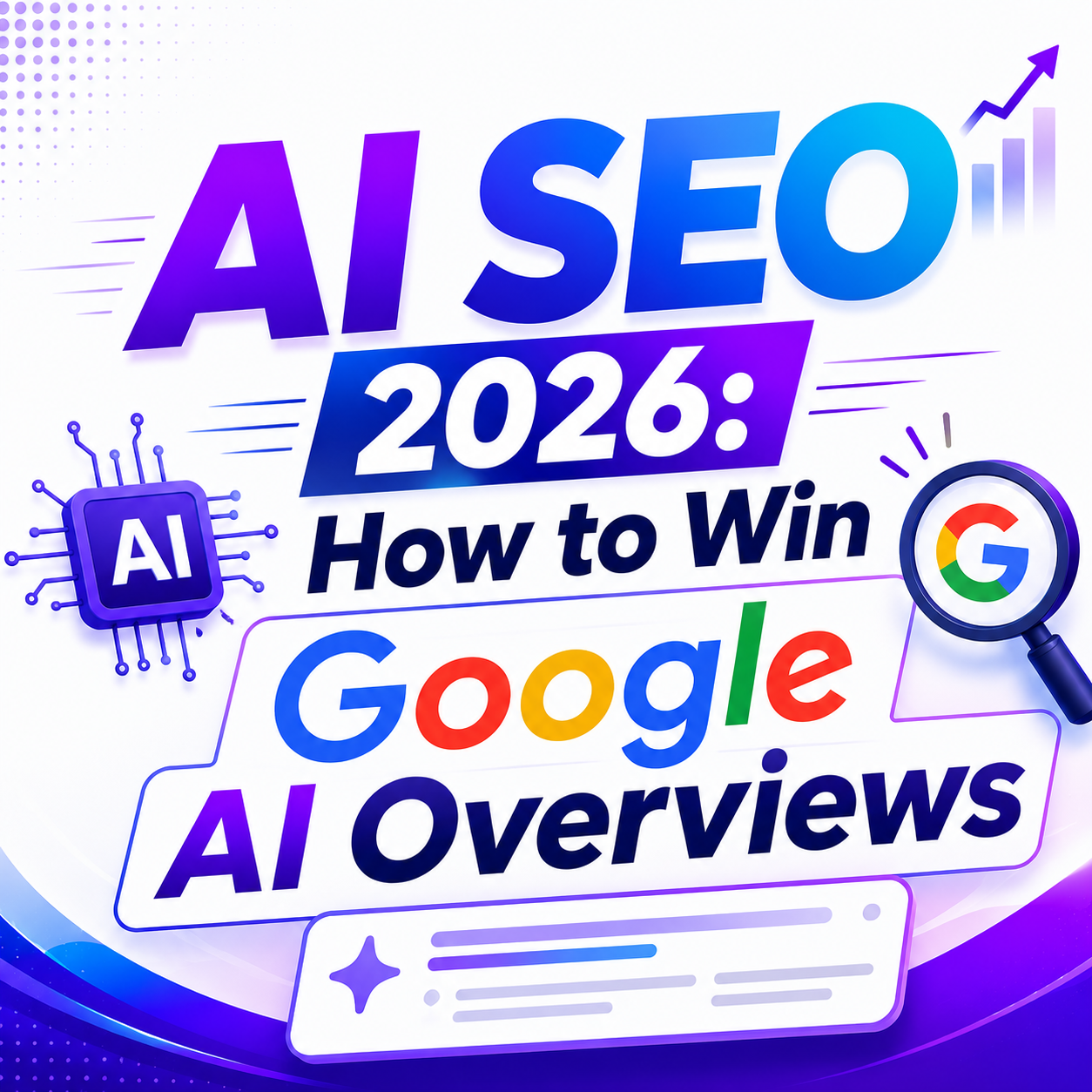
Google’s AI Overviews now appear on 48% of tracked search queries, and organic click-through rates can drop by 34-61% when they show up. AI SEO 2026 isn’t about chasing keywords anymore — it’s about proving to Google’s AI systems that your brand is a credible, citable source. Businesses that adapt now are already seeing recovery in clicks; the ones that don’t are losing visibility fast.
Why AI SEO 2026 Is Different From Traditional SEO
Search Engine Land and Seer Interactive report that Google’s AI Overviews CTR bottomed out at 1.3% in December 2025 before climbing to 2.4% by February 2026 — an 85% jump in just two months. But the real signal is who is winning those clicks: pages cited inside AI Overviews get 35% more organic clicks than pages that rank but aren’t cited. In other words, ranking on page one is no longer enough. Getting quoted inside the AI answer is the new prize.
Entity Clarity Beats Keyword Stuffing
Google’s Knowledge Graph now determines whether AI Overviews and AI Mode trust your brand enough to recommend it. Entity clarity means your website, social profiles, service pages, founder bio, and local listings all say the same thing consistently, so Google’s systems can classify your business without ambiguity. Practical steps include:
- Use consistent business name, address, and service descriptions across your site and directories
- Add author bios with real credentials to every blog post
- Mark up your content with schema (Organization, Person, Article) so machines can parse who’s saying what
- Keep your Google Business Profile and social bios aligned with your website copy
Generic Content Is Losing Ground Fast
Google’s Head of Search, Liz Reid, has emphasized that great content still needs to shine — but “great” now means first-hand experience, not recycled summaries. AI tools have made it trivially easy to produce derivative articles, which means the web is saturated with content that says nothing new. Google’s own guidance confirms that declarative claim structures, named-entity attribution, and statistics from credible sources drive higher citation rates in AI-generated answers.
To stand out, every article should include: a specific, sourced statistic in the first few paragraphs; a named expert or case study; and a clear, quotable answer to the reader’s exact question within the first 100 words. Brands with genuine expertise and a willingness to publish it have a structural advantage right now, simply because so few competitors are bothering to do the work. A short case study with real numbers, a founder quote with a job title attached, or an original chart built from your own client data will all outperform a generic “top 10 tips” roundup that repeats what fifty other sites already said this month.
What This Means for Local and Small Businesses
You don’t need an enterprise budget to compete in AI search. Local and small businesses actually have an advantage: proximity, specificity, and real-world availability are exactly the signals AI search systems are getting better at reading. A landscaping company in Tindivanam with a clearly named owner, consistent service-area listings, and recent, specific customer reviews will out-rank a national competitor with thin, generic pages for local and district-level searches. The trend toward micro-market competition — ranking by postcode, neighborhood, or intent cluster rather than broad national keywords — rewards businesses that lean into their local identity instead of hiding it.
Practical local moves include keeping your Google Business Profile updated weekly, encouraging detailed customer reviews that mention specific services, and publishing location-specific case studies rather than one generic “services” page trying to cover every city at once.
Measuring Success in an AI-First Search World
Traditional rank tracking still matters, but it no longer tells the whole story. Businesses should also track impressions and clicks specifically on queries where AI Overviews appear, whether their brand or content is being cited inside those AI answers, and how branded search volume changes over time as an indicator of top-of-funnel visibility. Tools like Google Search Console’s expanded AI performance reports, released in 2026, now make some of this visible directly — a meaningful shift from the near-total opacity of AI Overview performance in years past.
Actionable Steps to Win Back Clicks in 2026
Here’s what small and mid-sized businesses can do this quarter to adapt their AI SEO 2026 strategy:
- Audit your entity signals. Search your brand name and check that Google, LinkedIn, and your website all describe you the same way.
- Publish proof, not opinions. Case studies, original data, and client results outperform generic advice posts.
- Structure content for extraction. Use clear H2s, short paragraphs, and direct answers so AI systems can quote you accurately.
- Monitor AI Overview appearances. Track which of your queries trigger AI Overviews and whether you’re being cited.
- Don’t abandon technical SEO. Google has confirmed that core ranking and quality systems still underpin AI Overviews and AI Mode.
Common Questions About AI SEO in 2026
Does traditional SEO still matter if AI Overviews dominate the results page? Yes. Google has been explicit that AI Overviews and AI Mode are built on the same core ranking and quality systems as traditional search, which means fast sites, clean technical structure, quality backlinks, and helpful content remain the foundation. AI SEO 2026 is an addition to that foundation, not a replacement for it.
How long does it take to see results from entity clarity work? Most businesses see measurable shifts in AI citation and branded search within 8 to 12 weeks of cleaning up their entity signals and publishing genuinely original content, though competitive industries like health and finance can take longer given how frequently AI Overviews trigger in those verticals.
Should smaller businesses worry about AI search at all? Absolutely, and arguably more urgently than large enterprises. Zero-click behavior is rising across the board, so every local business depending on organic search traffic needs a plan for staying visible when a growing share of searchers never scroll past the AI-generated answer.
Conclusion: Adapt Your SEO Strategy Before Competitors Do
AI Overviews aren’t going away, and the businesses that build entity clarity and publish genuinely useful, well-sourced content are the ones earning citations and recovering lost clicks. Waiting on the sidelines means losing visibility to competitors who adapt faster.
Ready to future-proof your search strategy? Contact Gemeratech for expert digital marketing services in Tindivanam and beyond and start winning your share of AI-powered search results today.